


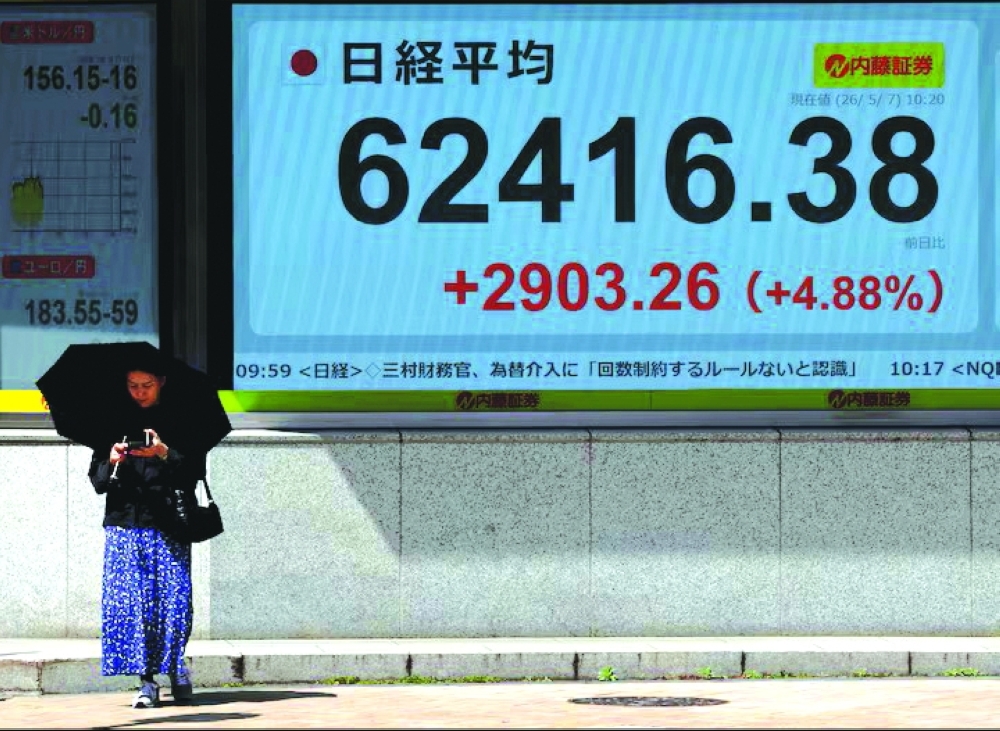





SINGAPORE : Asian stocks soared to record highs on Thursday, while the US dollar slipped and oil nursed steep losses on prospects of a US-Iran peace deal, even as the fate of the critical Strait of Hormuz remained unresolved.
Japan’s Nikkei returned from a long holiday to cross 62,000 for the first time, catching up with a blistering AI-led rally after robust earnings that also lifted South Korean and Taiwanese stocks to records.
MSCI’s broadest index of Asia-Pacific shares outside Japan rose 1%, hitting a record high. European stock futures pointed to a subdued open after the pan-European STOXX 600 rose 2% on Wednesday.
“An Iran deal would be a breakthrough, so the sparkling market reaction on Thursday was justified,” said Kyle Rodda, senior financial analyst at Capital.com.
“But we’ve seen this story before, and the rug could get pulled out of the market pretty quickly too. Ultimately, if we keep seeing progress in talks, Asian markets will keep rallying.” Iran said it was reviewing a peace proposal that sources said would formally end the war while leaving unresolved key US demands that Iran suspend its nuclear programme and reopen the Strait of Hormuz, whose closure has sent oil prices surging.
A potential deal to end the war sent oil prices sliding nearly 8% on Wednesday. Brent crude edged back up on Thursday to $102.11 a barrel.
Still, oil prices remain around 40% higher than when the conflict began at the end of February, while 10-year Treasury yields are around 40 basis points higher, underscoring the challenge facing the global economy from higher energy prices and related inflationary pressures.
Nick Twidale, chief market strategist at ATFX Global, said the market was still wrestling with execution risk, “both in terms of whether a deal is finalised and how quickly disrupted flows would normalise even if it is.” “WTI volatility highlighted this tension, with a sharp intraday sell-off followed by a partial recovery into the close.” Rocketing oil prices hit global markets in March, but a fragile ceasefire and the prospect of a deal have spurred a risk-on rally since April, further fuelled by strong earnings reports from technology companies.
S&P 500 companies are on track for their strongest profit growth in more than four years, while strong earnings from Samsung, SK Hynix and TSMC in Asia have added to upbeat sentiment.
Investors are awaiting the US non-farm payrolls report on Friday. Jobs are expected to have increased by 62,000 in April after rebounding by 178,000 in March, according to a Reuters survey of economists.
Federal Reserve officials said the war was raising the risk of a sustained inflation shock, with continued high oil prices and growing concerns over global supply-chain disruptions.
Yen stays in spotlight In currency markets, the euro held on to its overnight gains of around 0.5% and last traded at $1.1747.
Sterling stood at $1.3591 after rising 0.4% on Wednesday. The dollar index, which measures the US currency against six major peers, was at 98.032.
The yen remained in focus after recent spikes prompted market speculation that Tokyo had intervened to support the long-battered currency.
The yen last traded at 156.29 per dollar, little changed on the day, after hitting a 10-week high of 155 on Wednesday.
“Intervention alone is unlikely to shift the broader trend unless backed by stronger policy support, such as a more assertive BOJ hiking cycle or better alignment with external drivers such as lower oil prices and US yields,” OCBC analysts said in a note, maintaining a year-end target of 155.
Japan’s top currency diplomat said on Thursday the country faced no constraints on how often it could intervene and was in daily contact with US authorities.
The remarks by Atsushi Mimura, vice finance minister for international affairs, came ahead of a visit to Tokyo next week by US Treasury Secretary Scott Bessent, who analysts say is expected to discuss yen moves with his Japanese counterpart, Satsuki Katayama. _Reuters
Oman Observer is now on the WhatsApp channel. Click here


